American education is under fire again in the news media with the latest set of articles by Elizabeth Green, who works for a non-profit called Chalkbeat (and is plugging a new book). Her original article asks the question, “Why Do Americans Stink at Math?” and the follow-up article tells us “5 Ways to Help Your Kid Not Stink at Math”.
As a Montessori teacher, I am livid. My students do not “stink at math.” Rather, they master the concepts and thrive in high school and college classes. In fact, my students score as well as college-aged young people (post-high school score level) on nationally recognized standardized tests. These teens leave middle school with at least a credit for high school level Algebra 1, and most teens leave with credits for Algebra 1 and Geometry Honors. How? Montessori math materials and lessons.
Well-known Montessori teacher, trainer, and author Michael Duffy shows how well the Montessori math pedagogy and materials work, through scientific evidence and current brain research in his book, Math Works. (Math Works by Michael Duffy)
Over the past seven years, I have seen miracles worked through the use of these materials, teaching abstract math concepts with concrete manipulatives. I currently teach middle school students at Sea Pines Montessori Academy, but have also taught elementary students from ages six to twelve. (See “About” on my home page.)
What is Montessori? The curriculum was developed by Dr. Maria Montessori in Italy at the beginning of the twentieth century. She worked with children with Down’s Syndrome, developing materials to help them to learn basic life, math, and language skills. These materials worked so well that she begged the Italian government to try her method with children who did not have severe learning differences.
Dr. Montessori settled for a group of poor, neglected children in a tenement building in Rome. History was made. She turned unruly, uneducated children born into poverty into productive, self-motivated learners who were able to read by the age of four and five, and do complex math computations. (See Maria Montessori: A Biography by Rita Kramer.)
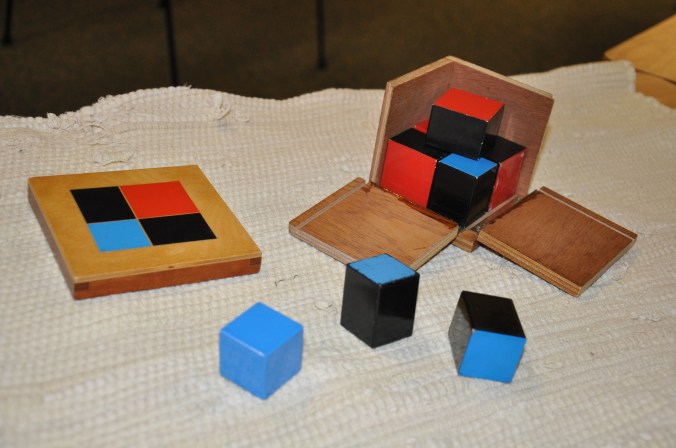
What are these special materials? Traditional educators like to call them “manipulatives.” Montessori materials are just concrete representations of math concepts like place value, numeration, value, quantity, area, volume, operations, and so forth.
For instance, she uses the colors green, blue, and red to represent the units (or ones), tens, and hundreds place values, respectively. Children learn the correct place value in numbers, fractions, and decimals through the use of these symbolic colors in “building” numbers by gathering a quantity of beads, wooden blocks, or counters in a certain color and matching the quantity to the name or value we give it, like 1,435.
The power of the symbolic colors and actual quantity of beads for a number is that children use these counters/beads to perform operations like addition, subtraction, multiplication, and division. They truly see that multiplication is serial addition. The children learn that division of a number involves evenly dividing the dividend among the divisor, and the answer to division is always what one “person” gets.
The children carry these mental pictures of operations for the rest of their lives. Dr. Montessori, along with her son, developed materials to represent algebraic concepts and geometric proofs. In an interview with Montessori high school students at School of the Woods, in Houston, Texas (one of the few Montessori high schools in the country), life-long Montessori kids told me that they still think of the materials when doing complex calculus. These mental images help them solve integrals (used to calculate area and volume).
When I read such articles as Elizabeth Green’s, and how the Japanese have found a “new way” to approach math, with the development of understanding of a concept, not just rote memorization, and how they help train teachers to give and perfect those lessons with peer observations, and that the teacher, above all, must reflect on what it means to be teacher, I just want to scream!!!
Dr. Montessori and her legions of disciples have been using and making materials for over one hundred years. To be a Montessori teacher, you need at least two years of training on pedagogy, child development, and materials use, design, and implementation. You also have peer and administrator observations to earn your credential. Finally, Dr. Montessori wrote that the teacher must spiritually prepare himself or herself to properly prepare the educational environment and help the child learn through activity.
I will leave you with some quotes from Dr. Montessori made over sixty years ago, with some made almost a hundred years ago. American educators and educational administrators need to get their heads out of their butts and go observe a successful Montessori school. You will see children who rock at math. You will also see what needs to happen in American education to make our children successful in life: academic mastery with meaningful social and emotional support in a caring community of self-motivated learners.
“If education is always to be conceived along the same antiquated lines of a mere transmission of knowledge, there is little to be hoped from it in the bettering of man’s future. For what is the use of transmitting knowledge if the individual’s total development lags behind?” Maria Montessori, unknown
“The senses, being explorers of the world, open the way to knowledge. Our apparatus for educating the senses offers the child a key to guide his explorations of the world…” Montessori, M. (1988). The Absorbent Mind. Oxford: Clio Press. p. 167
“Here is an essential principal of education: to teach details is to bring confusion; to establish the relationship between things is to bring knowledge.” Maria Montessori, From Childhood to Adolescence
“The vision of the teacher should be at once precise like that of the scientist, and spiritual like that of the saint. The preparation for science and the preparation for sanctity should form a new soul, for the attitude of the teacher should be at once positive, scientific and spiritual.
Positive and scientific, because she has an exact task to perform, and it is necessary that she should put herself into immediate relation with the truth by means of rigorous observation…
Spiritual, because it is to man that his powers of observation are to be applied, and because the characteristics of the creature who is to be his particular subject of observation are spiritual.” (Dr. Maria Montessori, ‘The Advanced Montessori Method – I’, Clio Press Ltd, 107)













 Sarah W Baird: Montessori Musings